Your media lives on your device first.
Your photos, videos and writing begin on your device. Putting a story on your website doesn't take it off your device.

HummHive is a protocol and an application to keep your media on your own devices and share it with the people you choose. Your photos, videos and writing live on your own devices, and you choose what you keep and who sees it.
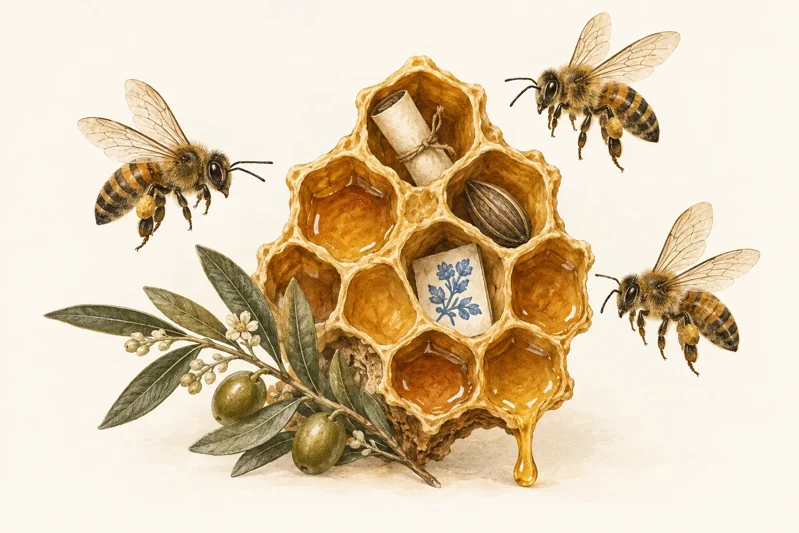
The bee in our logo comes from an Egyptian hieroglyph. HummHive's founder, Nick Haslem, spent time in Egypt and in the Amazon and Andes of Peru. That time inspired him to help preserve oral wisdom, stories and lore.
He carries responsibility as a pipe holder in the Toltec tradition of Mexico. He is steward of the land at Caterpillar Dreaming, where the Songlines begin.
We started with one question: how can people keep and share knowledge without cutting it off from the people who carry it? We want to give the people who carry it more choice over how they keep their stories and pass them on.
The same goes for anyone who makes things. Keep media on your own device, choose how to share it, and connect directly with the people it matters to.
Your photos, videos and writing begin on your device. Putting a story on your website doesn't take it off your device.
A Hive brings your material, people and tools together. You choose who joins it.
Send material to one person, post it to your Hive, or put it on your own website, served from your device while it's on. A Hive post stays off the open web unless you put it on your website.
Media, your own website and messages.
A place to keep your media, put stories on your own website and send messages, where you choose who sees what.
A town square where everyone talks with everyone all the time, strangers included.
Watch the team upload media and serve it as a website from their own device, in the Equinox briefing of 24 September 2026.
What runs today, what's being built now, and what comes after.
| Works now |
|
|---|---|
| On the roadmap |
|
HummHive is a protocol and an application. The application is what you see and click. The protocol is the rules underneath, so your device can share with other people's devices, peer to peer.
Your device connects to other devices running HummHive, including those of the people you share with. Servers help devices find each other and get past home routers.

HummHive was the first independent app built on Holochain. It uses Holochain’s peer-to-peer framework to connect people and their material. Holochain has featured HummHive as an ecosystem partner.
Visit Holochain’s websiteHummHive is a protocol and an application. The application is what you see and click: it keeps your photos, videos and writing on your own device and lets you share them with the people you choose. The protocol is the rules underneath, so your device can share them with other people's devices, peer to peer. A Hive brings your material, people and tools together.
A post in a Hive is visible to members of that Hive. It is public on the web only when it appears on your own website. The app's "Public" label does not, by itself, mean anyone on the internet can read the post.
Your material starts on your device. With no connection, you still see what is already on your device. To share, or to get what others share, you need a connection to other devices.
What you share privately is. In a Hive or a direct message, only the people you share it with can read it. Once someone has had access to something, they keep it. Your website is public on purpose, so what's on it is not encrypted. A Hive's name, logo, banner and description can be seen by people before they join.
Sidecars are small apps, like plugins, that add tools to HummHive, separate from its core. We built Note to Self as one. Building your own is planned, with docs to help.
Export into a fresh Hive.
Yes. Export your data as a file, then import it to create a fresh Hive. It's plain text, so keep it somewhere private.
Both: macOS, Windows and Linux on computers, and Android and iOS on phones.
The app is in private testing. The app demo on our homepage uses sample content; it is not the app itself.
Yes. Your website shows video and audio as well as photos and writing.